Wednesday, October 31, 2007

Article: Hope Rides

Hope rides on $75 loan
KENYA | Moms use micro-loans to operate small businesses, fight cycle of extreme poverty

By Cathleen Falsani
Religion Writer

October 5, 2007

NAIROBI, Kenya -- Around the corner from Grace's house in an impoverished neighborhood on the north side of Nairobi, the woman selling small purple onions slapped my hand, shook it and grabbed my fingers, smiling excitedly.

I didn't think anything of it until our traveling companion, Simon, said that the woman had told him in Swahili I was the first white person she'd ever met and touched.

In this part of the world, I am a mzungu -- a white person. And in the poorest of the poor neighborhoods here, such as the Kibera slums where an estimated 1 million people live in abject poverty on a piece of land about twice the size of Grant Park, mzungus like me are an exotic breed.

As my husband and I left Grace's house after she made us a cup of tea and told us a bit about herself, she presented us with a gift -- a set of hand-knit baby clothes (complete with matching infant balaclava) for our family's first grandchild, who is due to make his debut in late December.

'Mzungu! How are you?'

We said it was too much, that we couldn't possibly . . . but Grace, who supports her family by making the knit ensembles as well as colorful uniforms worn by all Kenyan school children, wasn't having it.

"If people see you with them, maybe they will ask where they came from and you can tell them about me," she said. "It is good for business."

Had I any doubt about the curiosity of my presence in Nairobi's poorer neighborhoods, it was confirmed when I heard children singing while walking in Kibera near a grammar school/orphanage (housed in a lopsided corrugated metal building painted a bold shade of azure.)

As I got closer to the school, I realized the "song" was more of a singsong chant a couple dozen children were yelling over a fence as they ran alongside us, some of them kicking an ersatz soccer ball made from a mound of plastic bags bound together with twine.

"Mzungu! Mzungu! How are you? How are you? Mzungu! Mzungu!" they sang at us, giggling and waving.

Apparently "How are you?" is one of the few English phrases known to most children here who speak Swahili as their primary language, even if they never attend school. And many children in Kibera do not because they cannot afford the uniforms that are compulsory even in Kenyan public schools.

A school uniform costs about 1,000 Kenyan shillings. That's about $15. Last week, I wasted more than that on a glass of wine. Never again.

I spent the better part of two days in Kibera earlier this week and was deeply humbled by my experiences there. Sure, some people stared at us, but some also invited us into their homes to visit, to tell stories, to bless us.

Chicago-based charity

It was in these homes that I understood just how mzungu I really am. Everything I see here, I am seeing with mzungu eyes. Everything I hear, I hear with mzungu ears. My challenge is to understand with a heart not colored by my nationality, class or skin tone.

While in Kibera, I met a number of women involved in a micro-investment program called Jikaze sponsored by the Chicago-based Global Alliance for Africa. Jikaze provides small loans to women in the slums who are trying to build small businesses that will enable them to feed their children, provide them with basic medical care and uniforms so they can attend school.

Mary sells dried corn and always puts an extra handful on top to keep customers coming back. Lilian sells carrots and other vegetables in Kibera's open-air market, waking at 4 a.m. to take a bus one hour each way to get her wares for the day. Margaret, a mother of nine, makes traditional embroidered African clothing and travels more than 500 miles round trip to Uganda to buy material at the best price.

A typical Jikaze loan is about 5,000 Kenyan shillings, or about $75. The women are expected to repay the loan within a year or so and are required to keep immaculate financial records before they can qualify for another, larger loan.

The day I dropped by the Jikaze Weavers' studio -- an 8-by-8-foot storefront along Kibera's main thoroughfare -- Floice, a mother of four who also cares for two orphan children, was working on a geometric-patterned wool rug. When I admired it, she said she would finish it by the next day if I'd like to buy it. We agreed on a price -- 2,500 Kenyan shillings.

Change for the better

It was only later that it dawned on me: What I bought as a souvenir without thinking twice is half of what Floice is hoping to get when her loan comes through sometime next year.

A throw rug for me. Food, clothing and an education for Floice's children.

Through an interpreter, Floice, a soft-spoken woman who was wearing a T-shirt with a portrait of Mother Teresa and the words "Peace begins with a smile" on it, told me she has faith she will find a good market and all the rugs she makes will sell.

And she said she has hope that the loan will come through sooner rather than later, so her life and the lives of her family will change for the better.

Seventy-five dollars, mzungu.

Think about it.

Tuesday, October 30, 2007

What To Do When Attacked By Monkeys

What should you do if you're surrounded by angry macaques?
By Michelle Tsai (slate.com)
Posted Monday, Oct. 22, 2007, at 6:59 PM ET


The deputy mayor of New Delhi, India, fell off his balcony and died Sunday after being attacked by monkeys, his family members say. The city has around 10,000 monkeys, some of which have taken to roaming through government buildings as they steal food and rip apart documents. What should you do if monkeys are picking on you?

It's like Mom said about muggers: Just give 'em what they want. When monkeys get aggressive, it's usually because they think you have something to eat. According to one study, about three-quarters of all the aggressive interactions between long-tailed macaques and tourists at Bali's Padangtegal Monkey Forest involved food. If you are holding a snack, throw it in their direction, and they'll stop bothering you. If you don't have any food, hold out your open palms to show you're not carrying a tasty treat or back away from the monkeys without showing fear. To diffuse the situation, don't make eye contact or smile with your teeth showing—in the nonhuman primate world, these are almost always signs of aggression.

Monkey attacks are extremely rare in the wild; the creatures tend to be scared of us and often scamper away when a person gets within 100 feet. As monkeys lose their habitats around the world, though, they've started to live in closer proximity to humans, and that causes conflict.

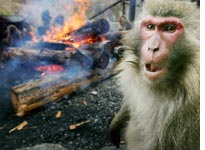
Angry Monkeys. Click image to expand.


Aggressive city monkeys will give you lots of warnings before an actual fight breaks out. First, the animals will look at you in the eyes, open their mouths, and bare their teeth. Rhesus macaques, the aggressive monkeys that cause a lot of the trouble in Delhi, will then warn you with a grunt. Next, they might fake a lunge toward you; this often causes a victim to lose his balance. If you're still withholding food, they'll grab at your knees and legs, and put their mouths on you so that you can feel their teeth. Finally, if you still won't cooperate, they'll sink their canines into you. The study in Bali found that most macaque bites don't break the skin, but a wound could allow transmission of herpes B, which can be fatal to humans. Baboons, which sometimes attack humans in Africa, are much more dangerous: They're bigger and less predictable, and they're armed with 3-inch-long canines. Last year, a South African man's forearms were ripped to the bone, and doctors dug out a baboon tooth during surgery.

What if you can't or won't appease the monkeys with food? You can try to chase them off by shaking a stick at them, but they might get violent if cornered. If they don't budge, bop 'em on the head; visitors to temples in India sometimes carry a stick for just this reason. Primatologists will sometimes send a macaque warning signal called the open-mouth threat. Basically, form an "O" with your mouth, lean toward them with your body and head, and raise your eyebrows. Female victims might seek protection in a group of men, since monkeys are somewhat afraid of males. But whatever you do, don't freak out; those who scream, wave their arms, and run away are only going to make the macaques even more aggressive.

Despite all the monkey business, Delhi has refused to cull the macaques, which are sacred because of the Hindu reverence for Hanuman, the monkey god. Instead, the government has relocated some of the troublemakers and even brought in langurs, a mellower but larger monkey, to scare off the smaller macaques.

- end of article -

emzadii: so now you know. consider yourself prepared... heee!

Monday, October 29, 2007

the pedia

Chicagopedia
source: the sun-times

Chicago
/ shi-kago / n. 1. a city of 3 million souls in northeastern Illinois; 2. any suburb or town within 100 miles of this city ("I'm from Chicago)"; 3. a popular musical ("We're going to see 'Chicago' "); 4. adj. reflecting a distinctive, possibly corrupt, practicality ("The Chicago Way"); 5. brutal, resembling a gangster. Chicago overcoat (a coffin) "A Chicago overcoat is what blasting would get you . . ." R. Chandler, The Big Sleep; Chicago pineapple (a hand grenade.)

Downstate / doun steyt/ n. Any place in Illinois outside of Cook, Lake, DuPage, Will, Kane or McHenry counties, even if it is actually farther north than Chicago, such as Rockford. "I don't know where that town is. It's probably Downstate."

The Magnificent Mile / mag NIF uh cent MY el/ n. The tiny stretch of North Michigan Avenue bordered by the Chicago River and Oak Street (The Wrigley Building to the Drake Hotel). The Greater North Michigan Avenue Association, which trademarked the name "The Magnificent Mile" in 2001, considers the borders to be Randolph Street and North Avenue, plus Lake Michigan to the east and the North Branch of the Chicago River to the west. But that's more than a mile. The name was coined in 1947 by developer Arthur Rubloff. Sometimes called the "Mag Mile," and, incorrectly, the "Miracle Mile" (see: Coral Gables, Fla.) Populated by high-end stores, flower planters and people from Iowa.

Soldiers Field /sol jers fee uhld/ n. What Soldier Field, home to the Chicago Bears since 1971, is called everywhere but in Chicago. The lakefront stadium originally opened in 1924 and was called Grant Park Stadium before being renamed -- in the singular -- in honor of soldiers -- plural -- killed in World War I.

Loop /loop/ n. Chicago's downtown district. Originally an area bounded by trolley-car cables, then by elevated train tracks; more recently anywhere west of the lake, east of Halsted, south of Division Street and north of Roosevelt Road. (Usage: Always preceded by "the'' -- "The next morning, when Maryanna and I arrived at the Loop in Chicago, we said goodbye." -- Jerry Stiller).

The Circle / sur kuhl / n. Radio traffic reporters' nickname for the notorious Circle Interchange, where the Dan Ryan, Eisenhower and Kennedy expressways meet, entangle and knot just west of the Loop. Not one of the nine Circles of Hell, but it could make a case for the 10th. Rated as the country's third-worst traffic bottleneck in 2004, with drivers losing a combined 25 million hours while stuck in it. Named for its interwoven, curving ramps. Also called "The Spaghetti Bowl." Built in the late 1950s and early '60s.

Taste /tayst/ 1. n. Shorthand for "Taste of Chicago," the summer public chow-down of Billy Goat cheeseburgers, Robinson's ribs and Eli's cheesecake; 2. An asphalt hellscape of sweaty Hoosiers in tank tops showing off tattoos and stuffing themselves with a variety of fried, deep-fried and double-fried food products, all expensive. 3. adj. Related to the Taste. e.g. Taste traffic, Taste backups, Taste arrests, Taste tickets, Taste stomachaches.

The L (thu el) n. The elevated commuter transit line in Chicago, even when it's not elevated.

The Jewels / thu juels / n. a large, full-service grocery store in Chicago and its suburbs. Refers typically, but not exclusively, to Jewel Food Stores. Usage: "I'm going to the Jewels for some meat." (Similar extraneous "s" word: Soldiers Field).

midway / mid wa / n. The area of a fair or carnival where sideshows and other amusements are located. Origin: Entered American vernacular during the Chicago World's Fair of 1893. The festivities were held on the "Midway Plaisance," a boulevard west of Jackson Park near the University of Chicago. The university's football team were the original "Monsters of the Midway." Today there are Midway movers, Midway funeral directors and Midway plumbers. Between 1976 and 2001 Midway Airlines operated out of Chicago's Midway Airport.

Pulaski Day / puh LAS key day / n. The first Monday of March in Illinois -- and a day off for Chicago Public Schools kids as well as City of Chicago and Cook County workers. Other school districts throughout the state also recognize the day. It honors Polish-born Brigadier Gen. Casimir Pulaski, a famed cavalry officer in Poland before joining the American Revolution and becoming a hero here -- and a source of great pride for Polish Americans. New York and Philadelphia also hold Pulaski parades, although they are in October.

cash station /kash STAY shun/ n. An ATM in Chicago. Origin: The name "Cash Station" was coined by First National Bank of Chicago's ad agency in 1979 and used for a network of automated bank machines in seven Midwestern states. The network was sold in 2001 and its machines were to adopt the STAR logo. But Chicago has resisted. An estimated 1,000 "Cash Station" signs remain here because banks know Chicagoans will better recognize them, says former Cash Station CEO Steve Cole. The generic use of "cash station" is a Chicago thing. "People tell me they go to New York and say, 'Where's the nearest Cash Station machine?' And people look at them and say, 'What the hell is that?'" Cole said.

Pop: (pahp) 1. n. a carbonated soft drink in Chicago, the rest of the Midwest and Canada. Synonyms: soda (on East Coast) and Coke (in the South); 2. n. a father. 3. v. to smack, say, in the nose; 4. n. a smack.

FIB / (fib) / 1. n. collq., acronym / derogatory term for an Illinois resident visiting Michigan or Wisconsin. Acronym includes "Illinois," among other words. Usage: "That FIB just cut me off." synonym: FIP, which substitutes "person" for another word.

cheeseheads /cheez hedz/ n. 1. People from Wisconsin. 2. Green Bay Packers fans. Origin: References the dairy industry, a major aspect of Wisconsin's economy, and the tendency of Wisconsin residents to limit their diets to cheese and milk, when not consuming beer and sausage. Syn. Knucklehead

alderman /AHL der man/ n. 1. Mayor of ward. 2. Protector of duck livers. 3. At times prey for federal investigators and corrupt developers.

Grabowski /grah bow ski/n.1.A hardworking, blue-collar, lunch-pail-carrying grunt, as made famous by Mike Ditka before a Bears playoff game in 1986. "There are teams named Smith and teams named Grabowski," Da Coach said. "The Rams are the Smiths. We're the Grabowskis."

Goethe / gothe / n. 1. An elegant little street at 1300 north running from 754 west to 86 east. 2. The statue of a buff guy with a bird on his knee at the north end of Lincoln Park. 3. Some German poet. Pronunciation guide: "Gothe" or "Goetha" is preferred by true Chicagoans who work for a living. "Gerta" is used by pointy-headed Hyde Park show-offs.


K-town / KAY-town/ 1. n. What West Siders often call the stretch of the city between Pulaski and Cicero. So named because more than 30 north-south streets there begin with the letter "K." Among them: Kedvale, Kenneth, Kenton, Kilpatrick, Knox and Kostner. A plan adopted in 1913, but only partially fulfilled, called for Chicago's street names to be alphabetized from the Indiana border going west: The first mile would be "A" streets, the second mile "B" streets, etc. Eleven miles out, that gave Chicago the "K" streets. After L, M, N and O streets, the scheme ended on the city's western edge with the "P" streets, such as Pontiac, Plainfield, Panama, Page and Pacific.

Uptown (up'town) noun. A once perennially downtrodden, now increasingly uptrodden section of the North Side roughly -- sometimes quite roughly -- around Broadway and Lawrence. A place, never a direction -- one cannot grab a cab going "uptown" in Chicago. "It is a crowded apartment in Uptown." Studs Terkel, Hard Times.

front room / (frunt room)/ also pronounced frunchroom or funchroom/ n. 1. A living room in Chicago, especially in a Chicago bungalow. In some parts, the front room is called the "parlor."

two-flat / too flat / n. A residential, two-story brick building with a common front entrance and separate residences on each floor. One floor is often reserved, reluctantly, for mother-in-law. Common source of extra income/aggravation for Chicagoans. Similar to three-flat.

gaper's block gay puhrs block/ n. 1. Congealed traffic between you and something really interesting; 2. The rolling audience for an accident or roadside oddity, such as the Dennis Rodman billboard near the Kennedy Expy. in 1996. Origin: The term was coined by Chicago Police Sgt. Irv Hayden, a "flying officer" who did helicopter traffic reports for WGN throughout the 1960s. He died in a helicopter crash in 1971. Barbara D'Amato: "Two uniforms stood in the street motioning cars past and generally preventing gaper's block.

oasis /oh a sis/ n. A tollway rest stop built over the road, allowing motorists in each direction to pull over and fill up on Chinese food, doughnuts, gyros and other essentials. Gasoline and rest rooms are also available. There are seven oases in the Illinois tollway system, some dating to the late 1950s.

Jays /jayz/ 1. adj. A manufacturer of potato chips, pretzels and other assorted salty snacks (usage note: there is no possessive apostrophe because there is no actual "Jay" -- the company was called "Mrs. Japp's Potato Chips" for the wife of founder Leonard Japp Sr., until the Japanese attack on Pearl Harbor on Dec. 7, 1941, forced a name change to ward off ruin). 2. n. a group of birds related to crows, only prettier.

Show /sho/ n. 1. A movie playing in a Chicago theater, or the theater itself. "Man, it's hot today. Wanna go to the show and cool off?" 2. An accident or incident that is none of your business. "Move along people, show's over."

couple two tree / (cup el too tree) / n. / The Chicago way to refer to two or three of something. Maybe even four. Usage: "Hey, let me get a couple two tree Old Style."

uh-huh /uh-huh/ exclm. 1. a weary or casual affirmation; 2. recognition that someone has apologized to you, bought something from you or thanked you; 3. code phrase for "you're welcome, thank you for shopping with us, please come again soon." "You still like me?" "Uh-huh, sort of." -- Nelson Algren.

hunnert /hun-ert/ n. The number that comes after 99. Example: "Who woulda thought da Sox would be eight games under five hunnert?"

Halsted Street / hawl-sted stret / -- 1. n. a thoroughfare at 800 W. running from 3766 N. to 12960 S. "They accepted, and we went through the big Halsted Street gate." Upton Sinclair, The Jungle; 2. adj. gay "We met at a Halsted Street bar"; 3. Greek "We ate spanakopita at a Halsted Street restaurant."

swim advisory /(swim ad vie zry)/ n. / Chicago Park District's delicate way of saying there might be too much bird poop or cheesehead sewage or something else gross in the water, so you might not want to swim. Not as strong as a "swim ban," when there is definitely too much bird poop or cheesehead sewage or something else gross in the water, so you can't swim.

trixie /tricks ee/ n. Derisive term for social-climbing, professional woman in her 20s or 30s, especially one from Lincoln Park, although migration has spread around the city. Attributes include: blond or blond-highlighted hair, ponytail, black Volkswagen Jetta or Honda Accord, nice purse, degree from large Midwestern university, well-manicured nails and no-foam skim latte. Immortalized by the tongue-in-cheek Lincoln Park Trixie Society.

A guy /a gi/ N. 1. A trusted, skilled and hard-to-replace practitioner -- male or female -- of whatever service needs rendering (shave-and-a-haircut, wing-tips resoled, cheating husband photographed in compromising positions). 2. Person frequently recommended to friends, relatives or even casual passersby in need of services rendered. 3. Major reason many Chicagoans will never leave Chicago. Idiom. "I got a guy."

buddy /budi/ n. & v. (alt. of BROTHER) n. A stranger, an oaf, a person unknowingly about to be arrested, hit or otherwise reminded of where he is and what he should be doing instead of what he is presently doing. Syn: pal, sport, slick. N. ALGREN: "'Are you for action or aren't you, buddy?' Big Stingaree wanted to know."

Italian beef / uh TALE yun beef / n. 1. Thinly sliced beef seasoned with garlic, oregano and other spices and served on Italian bread. A Chicago creation, it is slowly spreading nationwide thanks to transplants who can't do without it. The slow-cooked, top-butt meat can be eaten "dipped" (in beef broth), "sweet" (with sweet peppers), "hot" (with giardiniera), "cheesey" (with cheese) or as a combo (with an Italian sausage tucked beneath the beef). In Chicago, it's a source of pride, competition and dirty shirts. 2. A sandwich not known to be served anywhere in Italy.

graveyard /grayv-yahrd/ n. 1. Once a popular precinct for active Cook County voters in close elections. Officials have worked to purge the names of the dead from voting rolls -- but the county's reputation of dead people voting early and often is harder to cleanse. 2. Often the longtime home of a person being blamed in a current scandal. 3. Final resting place for many, unless it's in the way of a runway expansion project.

the woods thu woodz/ n. colloq. What Chicagoans call forest preserves. In some suburbs: places to unwind, hold a family picnic or take the kids for a stroll. In Chicago: places to find anonymous sex or dump a body. See: frightening locales, loafing maintenance workers, Snickers wrappers and church picnic. MOTHERS: "Stay out of the woods."
Friday, October 26, 2007

Article: Ways, Love, Words

Seven Ways to Tell Him You Love Him Without Words

By Susan Gifford

If you want to show your guy that you think he's special, you could just tell him you love him. He'll always want to hear that. And, of course, you can surprise him with the latest Palm Pilot or that Big Bertha golf club he's been begging for. But probably the best way to make a man feel loved is to offer some simple, everyday acts of kindness that show him you understand him. These little gifts will give something back to you: a marriage infused with more trust and friendship and a deeper sense of togetherness.

So go ahead and buy him a toy if you feel like it. But if you want to make him so happy he skips right past "Thanks, hon," to "I'm married to the woman of my dreams," give him one of these seven tokens of devotion. No shopping required.

Give Him a Cushion
Raise your hand if this sounds familiar: You and your husband screech home from work. While you hug each kid and liberate a Boboli from its plastic wrap, your husband is very busy, too...studying the mail. Seeking a way in, you ask how his day was. No answer. He's home, but he's not.

You're fuming, and that's understandable. But it turns out that men really do need a tiny buffer zone ‑- call it a cushion ‑- between work and family, says Deborah Tannen, Ph.D., professor of linguistics at Georgetown University in Washington, DC, and an expert in communication between the sexes. That cushion helps them change from "political" male with territory to defend to "loving" male with territory to share. "Many women use talk to reinforce the bond, but many men see talk as something they had to do all day to make sure they didn't get pushed around," says Tannen.

What's a woman to do? Tell him you understand his need to retreat but you just can't indulge it every night. Then discuss how ‑- and how often ‑- the two of you can build in a cushion without leaving the whole domestic load on you. For example, you might agree that one night he's with you and the kids, the next he gets to pull his turtle act for 10 or 15 minutes. The upside when he puts the mail or newspaper first? He'll feel more energized and ready to give you the break you'll need once he comes out of his shell.


Give Him Your Ear (Even When the Subject Seems Less Than Pressing)
Next time your husband demands your undivided attention to talk about the cool new office coffee machine, consider this: "For men, it's emotionally meaningful just to have a conversation," says New York clinical psychologist Alon Gratch, Ph.D., author of If Men Could Talk: Translating the Secret Language of Men, even if that conversation isn't about something that strikes you as emotionally meaningful. Politics, sports, the pros and cons of a push mower versus one that's gas powered ‑- these talks can make him feel as connected to you as you feel to him when he opens up about his emotions. And when chattering children and uncut vegetables interrupt the give-and-take, Gratch says, "it can make him feel he's not being heard."

Of course, putting down the paring knife and pulling up a chair can be a hard gift to give ‑- multitasking, after all, is what gets dinner on the table. But a little ingenuity can go a long way. Naomi Williams, a Website producer in San Francisco, catches conversations with her husband on the fly. "My husband's uncomfortable talking about his feelings, but he loves to talk about other stuff, so we call each other on our cell phones while we're driving or walking," she says. "He's always so happy when I call him. He'll say, 'Oh, I was hoping it would be you.'"


Give Him "Guy Time"
You are your husband's best friend, as he's likely to profess after a couple of beers. But sometimes he wants to go out with someone who won't roll her eyes when he turns into a human whoopee cushion. That "someone" is...The Guys. "Men get energy from being away," says JoAnn Magdoff, Ph.D., a New York psychotherapist. "They hang loose, talk or not talk. It gives them great intimacy without tremendous demands."

That said, we're not suggesting that he get a free pass every night while you deal with baths and bedtime. If you have two children under 3, for example, one evening out a month is generous. This is about meeting his needs within the realistic demands of family and work ‑- not about your being a martyr. (While you're at it, remember to pencil in girls' nights out.)

Bonus: If you each use some of this free time to pursue your separate passions ‑- whether it's dragging a friend to see the jam band Phish or taking Brazilian dance lessons with a pal ‑- there's likely to be an extra spark when you get back together. Maintaining separate identities keeps alive those parts of you that you two fell in love with in the first place.


Give Him What He Wants (Before He Knows He Wants It)
My husband becomes disproportionately happy if I replace the box of Mallomars before it's empty and equally pouty if I don't pour him a cup of coffee with my own in the morning. These reactions aren't out of whack, says Pat Love, Ed.D., author of The Truth About Love.

Little acts of thoughtfulness, or lack thereof, relay something bigger to our partners. "It's about tuning in to his needs, making the discovery of them a priority," she says. So try this next time he has a lot of job stress: If he ordinarily picks up the groceries, tell him you'll take over for a while so he can have some time to himself. "Actions like that touch his soul," says Love. "He thinks, You've been watching me. I'm important to you."

Of course, anticipating his needs also obviously applies to the bedroom. But if "give him sex before he has to ask for it" sounds too much like advice your mom would give, try looking at it this way: Being pursued reminds your man of when he was single and actually got hit on fairly regularly. And when he's feeling that manly and attractive, there's no telling what he'll want to do to you.


Give Him Your Admiration
A lot has changed over the last 40 years, but one thing remains the same: Your guy's self-esteem is tied up in how well he handles the job of being a "real man" ‑- his performance at work, in bed, as a dad. Stay mum about these subjects and it won't matter if he's a superstud with a six-figure salary. He'll...wonder.

"Men are still trying to get their mothers' approval, and you represent that feminine approval," says psychologist Gratch. So give freely, and give often, making sure you keep your praise genuine and, well, masculine. (Sad to say, complimenting him on his sensitivity will please him because it pleases you, but it won't massage him in those little-boy spots that most need the rub.) And remember to focus the compliment on him. If he gets a promotion, for example, instead of saying, "Great, we can use the extra money," try, "Wow, they finally see how hard you've been working."


Give Him His Adulthood
You can lecture him about his McDonald's habit and stock the kitchen with fresh fruit. You can count out loud the number of cocktails he has with dinner. But you can't -- repeat, can't -- make him take care of himself, drive more carefully, or work out his relationship with his parents. He will handle those things when he decides to. Too much input makes him feel guilty and harped on ‑- and will probably backfire.

"Mother him and he'll act like a child," says Gratch. "You give a great gift to a man when you stop trying to control his irresponsible behavior. He's got to learn from his own mistakes."

You also give a great gift to your marriage, because the risks of playing mommy are insidious: You'll slip from being equals to being parent and child, and that makes it awfully hard for you to respect him and for him not to resent you. (Of course, if the problem is serious ‑- he's drinking or gambling too much, taking drugs, or seriously risking his health ‑- you must decide for yourself what you will and won't live with.)


Give Him His Dreams
If he tells you that someday -- not tomorrow, not next month -- he'd really like to hike the Appalachian Trail, try biting your tongue before you say, "Uh-huh. And who's going to take care of the kids while you're gone?" We all need dreams. With days that are packed with demanding jobs, exuberant children, and circles of friends and family, life at this stage of the game is rich and rewarding. But it also leaves little room for real adventure. Dreams connect us to a past that felt limitless and promise a future that's a bit freer.

"Just try to make your interactions more positive than negative," says author Love. "It may be honest that you can't afford his dream, or that it's impractical or unrealistic. But the bigger truth is, do you want to be connected and supportive, or do you want to be the one who rains on his parade?"

Be the sunshine, Love advises. If you are, you can rest assured that he'll do his best to keep you warm too.

Tuesday, October 23, 2007

Sou eu assim sem você...


Fico Assim Sem Você
by Adriana Calcanhoto
from the Turistas soundtrack
(untuk ms pujaan hati...)

Avião sem asa, fogueira sem brasa
Sou eu assim sem você
Futebol sem bola, Piu-Piu sem Frajola
Sou eu assim sem você

Por que é que tem que ser assim?
Se o meu desejo não tem fim
Eu te quero a todo instante
Nem mil alto-falantes
Vão poder falar por mim

Amor sem beijinho, Buchecha sem Claudinho
Sou eu assim sem você
Circo sem palhaço, namoro sem abraço
Sou eu assim sem você

To louco pra te ver chegar
To louco pra te ter nas mãos
Deitar no teu abraço, retomar o pedaço
Que falta no meu coração

Eu não existo longe de você
E a solidão é o meu pior castigo
Eu conto as horas pra poder te ver
Mas o relógio tá de mal comigo, por que?...poooor que...

Neném sem chupeta, Romeu sem Julieta
Sou eu assim sem você
Carro sem estrada, queijo sem goiabada
Sou eu assim sem você
Por que é que tem que ser assim?
Se o meu desejo não tem fim
Eu te quero a todo instante
Nem mil alto-falantes
Vão poder falar por mim

Eu não existo longe de você
E a solidão é o meu pior castigo
Eu conto as horas pra poder te ver
Mas o relógio tá de mal comigo
Eu não existo longe de você
E a solidão é o meu pior castigo
Eu conto as horas pra poder te ver
Mas o relógio tá de mal comigo


vivo 1:


vivo 2:

Friday, October 05, 2007

unspeakable

you just had to do it, didn't you?
always wanting the final word, right?
always looking for that last lunge of the blade?

on my birthday weekend, no less.

*sigh.....*

friday 28th, came back from work feeling utterly deflated by her.
and the emotional exhaustion sank in. *again*
locked the door, practically crawled into bed.
and slept (literally) for days.

workday monday. zombie-like. september's gone.

threw up at work mon tue wed.
still hadn't eaten nothing.

collapsed. illness finally overwrought me.

: (
this is what happens everytime she reappears into my life.
i am thrown into the torment of a depression unspeakable.


unhappy birthday, syamil
courtesy ain.